I am a Research Engineer in the Google DeepMind working on Gemini Robotics models to make them fast adaptable to unseen tasks and unseen embodiments. Before Google DeepMind, I worked on Google Search Ranking algorithms for 4 years.
Writing
Selected Work at Google
Gemini Robotics On-Device 2 — Fast Adaptation to Unseen Embodiments
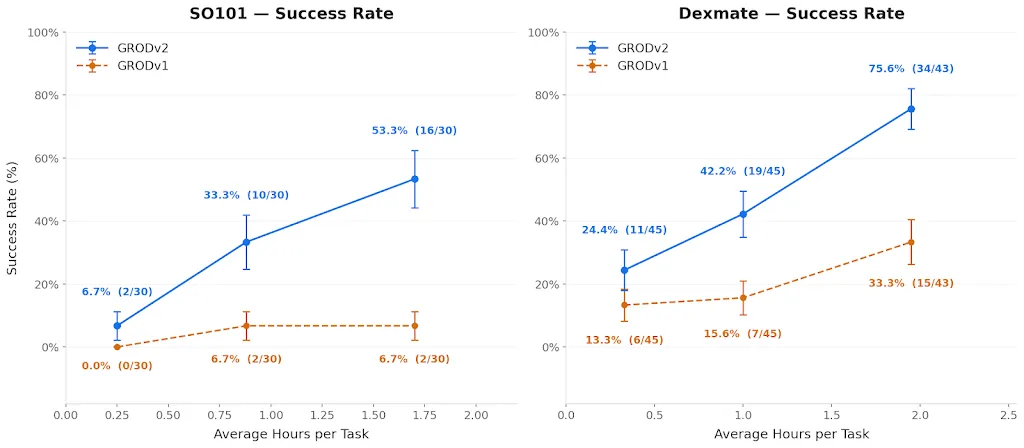
Fast adaptation of Gemini Robotics On-Device 2 to embodiments the model has never seen. With roughly two hours of task data per embodiment, GRODv2 reaches 53.3% on SO101 and 75.6% on Dexmate, against 6.7% and 33.3% for GRODv1 — and on SO101 the v1 curve is flat, so the gain is adaptation speed rather than a better starting point. More in my thread.
CLIFT — Turning Gemini Robotics On-Device into Humanoid Specialists
Non-invasive closed-loop iterative fine-tuning: adapting a closed-weight robot foundation model into a humanoid specialist through a managed fine-tuning API, with no access to weights, gradients, or training internals. Across box packing, cup insertion and bimanual plate handover, the same procedure lifts Gemini Robotics On-Device considerably further than it lifts π0.5 — the loop compounds on the stronger prior rather than closing the gap to it.
Why I like it, from my thread:
This is the type of RL I love. No Dagger, no policy gradient, no reward collapse. A well-calibrated VLM critic to label the rollout data, a careful conditioning in the text prompt and a SFT API will do the trick.
Few-Shot Adaptation Finetuning — Gemini Robotics
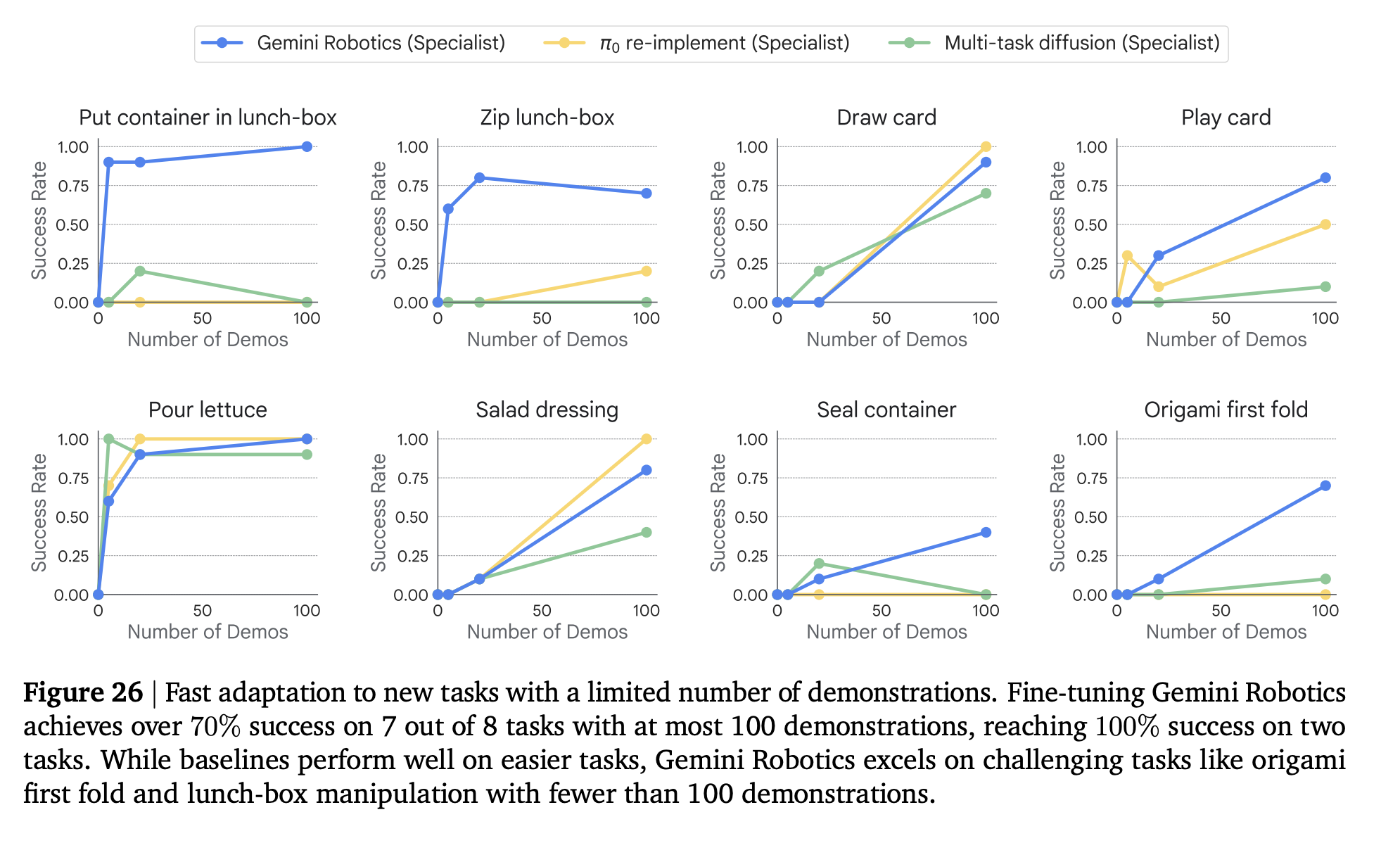
Few shot adaptation finetuning experiments (Fig. 26) in the Gemini Robotics Technical Report.
Gemini Robotics On-Device
Built the finetuning service and SDK for Gemini Robotics On-Device for Trusted Testers (GitHub SDK). Demo videos below (edited by me):
Topic-Authority Ranking — Google Search
Developed the Topic-Authority-based ranking algorithm for Google Search.
Open-Source Tools
I love building tools. Whenever I find there are no tools that fit my use case nicely, I start building my own.
sklearn, pytorch, and more.